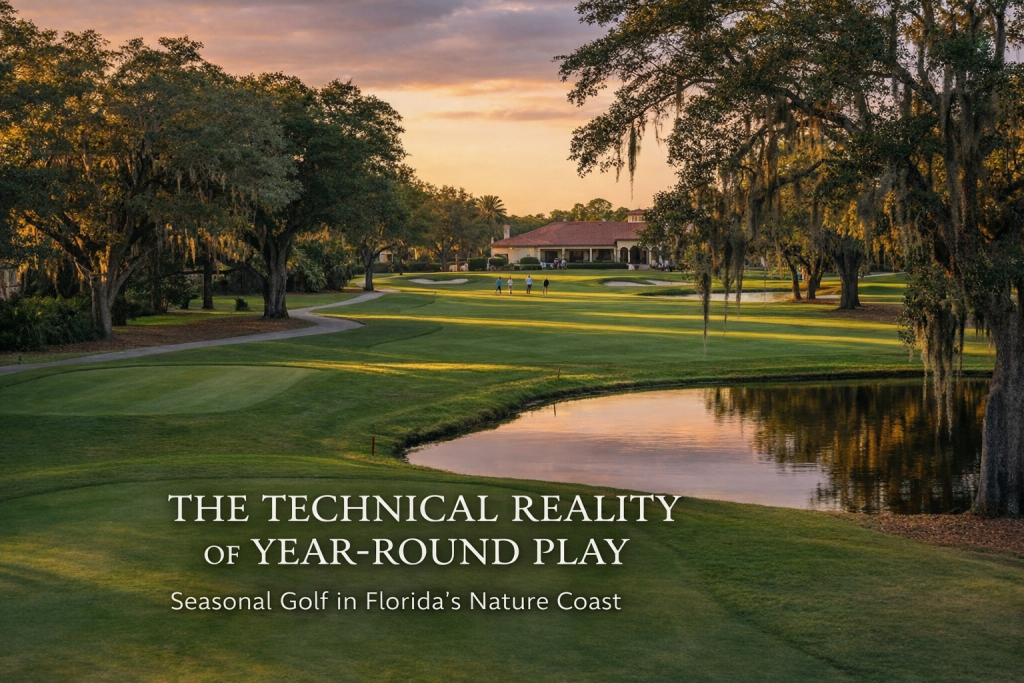
The decision to acquire a property on Florida’s Nature Coast—specifically within Marion and Citrus Counties—is often a strategic one, driven by the pursuit of a specific, high-quality lifestyle. For the sophisticated buyer, this lifestyle is frequently anchored by access to premier golf. Unlike the manicured, high-density courses of South Florida, the Nature Coast offers a more authentic, rugged, and architecturally significant golf experience. However, to truly master the local game and maximize the value of a golf course property, one must move beyond the casual understanding of “year-round” play and embrace the technical reality of seasonal golf.
This is not a discussion of preferred tee times; it is an analysis of turfgrass biology, course maintenance cycles, and the distinct environmental pressures that define playability across the calendar year. Understanding these cycles is essential for the Legacy Lifestyler who views golf as a vital part of their asset and their physical vitality. The course conditions change, and the player who understands the why behind the what is the one who truly earns the lifestyle.
The Annual Cycle: Turfgrass and the Florida Climate
Florida’s climate, particularly in the central-west region, operates on a distinct binary that dictates the rhythm of course conditions. The common misconception is that Florida is perpetually summer. The reality is a clear division between the Peak Season (roughly November through April) and the Off-Peak Season (May through October). This cycle is defined by two primary factors: temperature and precipitation.
The dominant turfgrass on high-end Florida courses is typically a variety of Bermuda grass (e.g., TifEagle, Celebration, or Paspalum), a warm-season grass that thrives in heat and humidity. This grass enters a state of semi-dormancy when nighttime temperatures consistently drop below 60 degrees Fahrenheit, which is common during the winter months in the Nature Coast. This biological reality necessitates the most significant maintenance practice of the year: overseeding.
Overseeding is the technical term for planting a cool-season grass, typically perennial ryegrass, directly into the dormant or semi-dormant Bermuda base. This is done to maintain a dense, green playing surface during the cooler months. While aesthetically pleasing and necessary for peak season play, this process fundamentally alters the course’s characteristics. The ryegrass is softer, requires more water, and often results in a slightly slower, “stickier” green surface compared to pure, fast-running Bermuda. The transition period, usually in late October and early November, is a critical time when courses are at their most vulnerable and playability is intentionally compromised for the sake of the upcoming season.
Peak Season Play: The Winter Golf Advantage
The Nature Coast’s winter months offer what many consider the most pristine playing conditions in the state, making this the true peak season play window. The climate is characterized by low humidity, moderate daytime temperatures (often in the 70s), and minimal rainfall.
Course Conditions: During this period, the overseeded fairways are lush and green, offering excellent lies. More importantly, the low humidity and cooler temperatures allow superintendents to manage the moisture content of the greens with precision. This results in firm, fast, and consistent putting surfaces. The ball will run out on the fairways, and approach shots will demand a higher degree of aerial control. This is the time when the courses are designed to play their most challenging and rewarding.
The Trade-Offs of Winter Golf: The primary trade-off for these ideal conditions is traffic and cost. The influx of seasonal residents and tourists means tee sheets are packed, and the pace of play slows considerably. Furthermore, the cost of maintaining the overseeded turf—including the labor, seed, and increased water usage—is reflected in the higher green fees and membership dues. The player must accept that the course is operating at maximum capacity, and while the conditions are superb, the experience is less solitary.
For the property owner, winter golf is a clear signal of the asset’s value. A well-maintained course during this season is a testament to the community’s financial health and commitment to quality, which directly supports property values. The ability to step out onto a course in January that rivals the best conditions found anywhere in the country is the core value proposition of golf course living in this region.
Summer Golf: The Technical Challenge and the Local’s Secret
The transition to the summer golf season—the Off-Peak—is marked by the “grow-in” period, typically beginning in May. As temperatures rise and the Bermuda grass aggressively emerges from dormancy, the ryegrass begins to die off. This is a crucial and often misunderstood phase of the annual course maintenance cycle.
Course Conditions: Summer play is defined by heat, humidity, and the daily threat of a torrential afternoon thunderstorm. The Bermuda grass is in its element, growing rapidly and requiring constant attention. The conditions are softer and slower. Fairways are spongier, and the greens, while pure Bermuda, must be kept slightly slower and softer to manage the stress of the heat and the constant moisture. The ball will not roll as far, and the greens will be more receptive to approach shots.
The Maintenance Reality: This is the time for aggressive course maintenance. Superintendents use the lower traffic to perform necessary cultural practices that would be disruptive during the peak season. This includes:
- Aeration: Punching holes into the greens to relieve soil compaction and allow air, water, and nutrients to penetrate the root zone. This is a short-term disruption that is vital for long-term turf health.
- Verticutting and Topdressing: Aggressive grooming to remove organic matter (thatch) and apply a thin layer of sand to smooth the surface and promote a firmer, faster roll once the heat breaks.
- Deep Watering: The intense heat requires significant irrigation, which contributes to the softer conditions.
For the resident who lives the lifestyle year-round, summer golf is the local’s secret. While the conditions are technically softer and the maintenance schedule is more aggressive, the benefits are substantial:
- Pace of Play: Tee sheets are wide open, allowing for a relaxed, faster round.
- Cost Efficiency: Green fees and resort rates drop significantly.
- The Purist’s Test: Playing in the heat and humidity demands a different kind of focus and conditioning, appealing to the “rugged” aspect of the Nature Coast lifestyle. It is a direct, candid test of one’s game, minus the crowds.
The Nature Coast Advantage: A Strategic Asset
The Nature Coast, spanning Marion and Citrus Counties, offers a unique geological and environmental backdrop that influences its golf courses. The rolling terrain, a departure from the flat coastal plains, provides natural elevation changes and drainage that contribute to better course conditions year-round. This is particularly relevant to the data-driven buyer who prioritizes geological stability and asset preservation.
The golf communities here are often designed with a focus on ecological authenticity, rejecting the “concrete jungle” aesthetic. The courses are integrated into the landscape, featuring mature oaks, natural wetlands, and a quiet sanctuary feel. This design philosophy translates directly into a more sustainable and less financially volatile asset. A course that works with the natural environment requires less artificial intervention, which is a key indicator of long-term HOA solvency and lower risk of special assessments—a critical factor for the Calculated Steward.
The decision to purchase a home on a Nature Coast golf course is not merely about having a short commute to the first tee. It is a strategic investment in a community that values vitality, technical excellence in maintenance, and a direct, unvarnished approach to the game. Whether you prefer the firm, fast conditions of winter golf or the quiet, challenging humidity of summer golf, the local expertise here is that the game is always on.
Conclusion
The reality of seasonal golf in Florida’s Nature Coast is a technical narrative of adaptation and precision. The courses here are managed by professionals who understand the biological demands of the turf and the expectations of a sophisticated clientele. They execute a rigorous course maintenance schedule that ensures high-quality play during the crowded peak season play of winter and a challenging, solitary experience during the quieter summer months.
The laid-back hustle of the Nature Coast means we focus on the facts: the conditions change, the maintenance is aggressive, and the experience is always authentic. There is no sales-y fluff here—just the direct, candid truth that a well-maintained golf course property is a high-performance asset that delivers a premier lifestyle 365 days a year, provided you understand the rhythm of the land. The game is always ready; the question is, are you?